Kitchen Sinks Built Into Stone: The Design Move Every New York Kitchen Needs Right Now
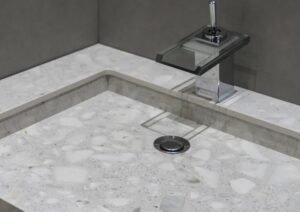
If you’re redesigning a kitchen in New York and want a clean, seamless look an integrated stone sink is one of the best decisions you can make. No separate basin, no visible rim, no grout lines collecting grime around the edges. Just one continuous surface that looks like it was always meant to be there.
We’ve been helping homeowners across Brooklyn, Manhattan, and New Jersey choose and install natural stone for over a decade. And in the last couple of years, the number of people walking into our showroom asking about kitchen sinks design in New York built directly into the stone slab has gone up significantly. It’s not a trend that’s going away. If anything, it’s becoming the new standard for high-end kitchen renovations.
This post covers everything you need to know which stone types work best, what the design options actually look like, what it costs, and what questions you should ask before you order anything.
Why Integrated Stone Sinks Are Having a Moment in New York Kitchens
New York kitchens especially in Brooklyn brownstones, Manhattan apartments, and New Jersey homes tend to be either very compact or very open-plan. Either way, visual clutter is the enemy.
A kitchen slab in New York that runs wall to wall with a sink carved right into it reads as one clean line. That’s exactly what open-plan living demands. There’s nowhere for mess to hide at the edges, and when it’s wiped down, it looks like a showroom every single time.
There’s also a hygiene argument. The joint between a traditional drop-in sink and the countertop is where bacteria, food residue, and water collect and most people don’t clean it nearly as often as they should. An integrated sink eliminates that joint entirely. That alone has convinced a lot of our Brooklyn clients to make the switch.
The 3 Stone Types That Work Best for Integrated Sinks
Not every stone handles the demands of a kitchen sink area equally. Here’s what we’ve seen work consistently across hundreds of installations.
Statuario Marble For Kitchens That Want to Make a Statement
Statuario marble is one of the most requested stones at our Brooklyn showroom, and for good reason. The white base with dramatic grey veining is genuinely stunning when carved into a single sink basin. It photographs beautifully, and it gives a kitchen that editorial, high-end feel that’s hard to replicate with any other material.
The honest caveat: marble is a calcium-based stone, which means it can etch if you leave lemon juice, vinegar, or acidic cleaners on it for too long. In a kitchen, that’s a real consideration. Our recommendation is always to seal it properly at installation and reseal it once a year. With that routine in place, a statuario marble sink holds up beautifully even in an active kitchen.
If you’re based in New York and you want to see the slabs we currently have in stock, come into the showroom the veining varies slab to slab and it’s genuinely worth seeing in person before you commit.
Quartz For Families Who Cook Every Day
Engineered quartz is the most practical choice for an integrated kitchen sink, full stop. It’s non-porous, which means it doesn’t absorb liquids, doesn’t need sealing, and is highly resistant to staining. The surface is consistent you don’t get the slab-to-slab variation you see with natural stone.
For families with kids, for people who cook daily, or for anyone who doesn’t want to think about stone maintenance quartz is the answer. We carry a wide range of quartz slabs at our New York location, from clean whites that mimic marble to darker tones that work beautifully in modern kitchens.
One thing to note: quartz can be damaged by sustained extreme heat, so don’t put a 300-degree pan directly on it. But for everyday kitchen use including sink areas that deal with hot water, soap, and constant contact quartz performs better than almost any natural stone.
Granite For Kitchens That Take a Beating
Granite is the most durable natural stone option for a kitchen sink. It handles heat well, resists chips and scratches better than marble, and its slightly textured surface hides minor marks that would be obvious on a polished white surface.
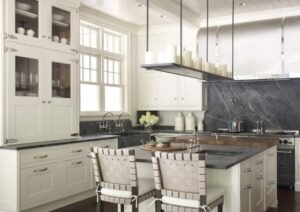
Steel grey granite in particular has been one of our most popular choices in Brooklyn kitchens it works with both modern stainless hardware and warmer, wood-toned kitchen designs. It’s also one of the most competitively priced natural stone options we carry.
If your kitchen is a working kitchen meaning multiple people cooking, heavy pots, busy evenings granite gives you the looks and the durability without asking much in return.
Design Styles: What Actually Looks Good (and What Doesn't)
There’s more than one way to integrate a sink into a stone slab. Here are the styles we install most often, and what they work best with.
Undermount flush integrated sink – The basin is carved into the stone so the top edge sits perfectly level with the counter surface. The cleanest look. Works with any stone. Best for minimal, contemporary kitchens.
Farmhouse apron-front in stone – The front face of the sink extends past the cabinet below, creating a visible stone apron. It’s a traditional design executed in a premium material. Looks exceptional in statuario marble. Works well in both classic and transitional kitchens.
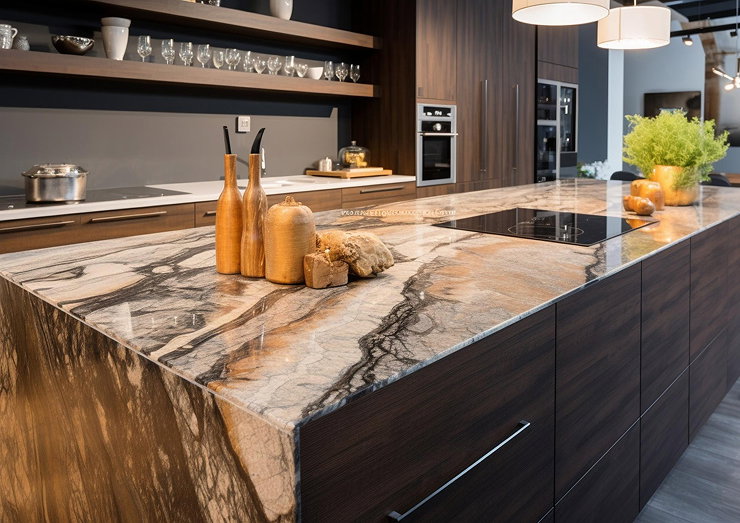
Waterfall edge sink – The stone continues over the front of the island or counter and drops vertically to the floor or cabinet face. The sink is integrated into this continuous form. Dramatic and architectural. Best for islands, not wall-mounted counters.
Trough sink for prep islands – A long, shallow basin running the length of a prep island. Practical for professional-style kitchens where multiple people are working at once. Granite handles this best due to depth and durability.
Vessel-style stone basin – The sink sits slightly proud of the counter surface rather than flush with it. It works best as a statement piece more common in bathrooms but increasingly requested for kitchen islands in high-design New York homes.
What doesn’t work: an integrated sink in a stone that hasn’t been properly edge-finished. The interior edges of the basin need to be smooth, well-sealed, and consistently profiled. Rushed fabrication shows immediately you’ll see uneven edges, inconsistent depth, and polishing marks. Always ask to see examples of your fabricator’s previous integrated sink work before you sign off on anything.
5 Questions to Ask Your Fabricator Before You Order
Before you sign off on any integrated stone sink project, make sure you get clear answers to these:
- What’s the minimum slab thickness for the basin?
The carved area needs enough depth without compromising the structural integrity of the stone. For most sinks, you want at least 3cm thickness in the slab. - Where will the drain be positioned, and who coordinates with plumbing?
The drain placement needs to be confirmed before fabrication begins. Changing it after cutting is either impossible or very expensive. - What edge profile options do I have for the inside of the basin?
Eased, bullnose, ogee the interior edge finish affects both looks and how easy the sink is to clean. - What sealing schedule do you recommend for this specific stone?
Every stone is different. A fabricator who gives you the same answer for marble and quartz doesn’t know their materials. - Can I see examples of integrated sinks you’ve fabricated before?
Not stock photos. Actual work. If they can’t show you, that tells you everything.
Frequently Asked Questions
Yes, marble is regularly used for integrated sinks, particularly in high-end New York kitchen renovations. The key is proper sealing at installation and annual resealing to protect against etching from acidic liquids. With the right maintenance routine, a marble integrated sink holds up well even in an active kitchen.
For low-maintenance, quartz is the top choice non-porous, no sealing required, extremely durable. For aesthetics and prestige, statuario marble is the most requested. For durability in a heavy-use kitchen, granite particularly steel grey granite performs best. At HG Stones in Brooklyn, we carry all three and can show you the slabs currently in stock.
A properly fabricated and maintained stone sink will outlast the kitchen itself. Granite and quartz sinks can realistically last 30 to 50 years with basic care. Marble sinks last just as long when sealed correctly, though the surface may develop a patina over time that many homeowners actually prefer.
Quartz wins on maintenance it’s non-porous and needs no sealing. Granite wins on heat resistance and gives a more natural, varied appearance. For most New York families, quartz is the more practical long-term choice. For a more natural stone look with maximum durability, granite is hard to beat.
HG Stones has a showroom in Brooklyn where we display marble, quartz, and granite slabs. You can see the actual materials not just samples and talk through your kitchen dimensions with our team. We also serve customers across New Jersey and Manhattan. Contact us to arrange a visit or request an on-site quote.
Come See the Stones in Person
Reading about statuario marble and quartz is one thing. Standing in front of a 10-foot slab and seeing how the light moves across it is something else entirely.
If you’re in Brooklyn, Manhattan, or anywhere in New Jersey and you’re seriously looking at a kitchen renovation come into our showroom. Bring your measurements if you have them, or just come to look. We’ll show you the slabs we have in stock, walk you through what works for your space and budget, and give you honest advice about what to choose.
No pressure. Just stone.